Card 01 · From Chapters 5–6
The Camp Line Card
How to read the servery before you pick up a tray. Palm, fist, thumb. The ten-second, three-question check that replaces a food scale. No arithmetic, no phone out in front of the crew.
Breaking News: Oil Patch Workers!!
4/3 through 21/7. Camp or drive-in. Days or nights. Written by a twelve-year oil patch veteran still on the crew at Fort Hills. Built on the On/Off Method — two modes, because you live two lives. Book, audiobook and the Hitch Fit App.
Get The Lean & Strong Body Protocol Now!Book · audiobook · 2 field cards · App free 120 days, then $27/mo, cancel anytime · Full refund inside three hitches, keep everything
Or take all five — Founding Crew $197 · 100 seats · Closes October 10
Get all five instead — $197 →Get all five — The Complete System $297 →
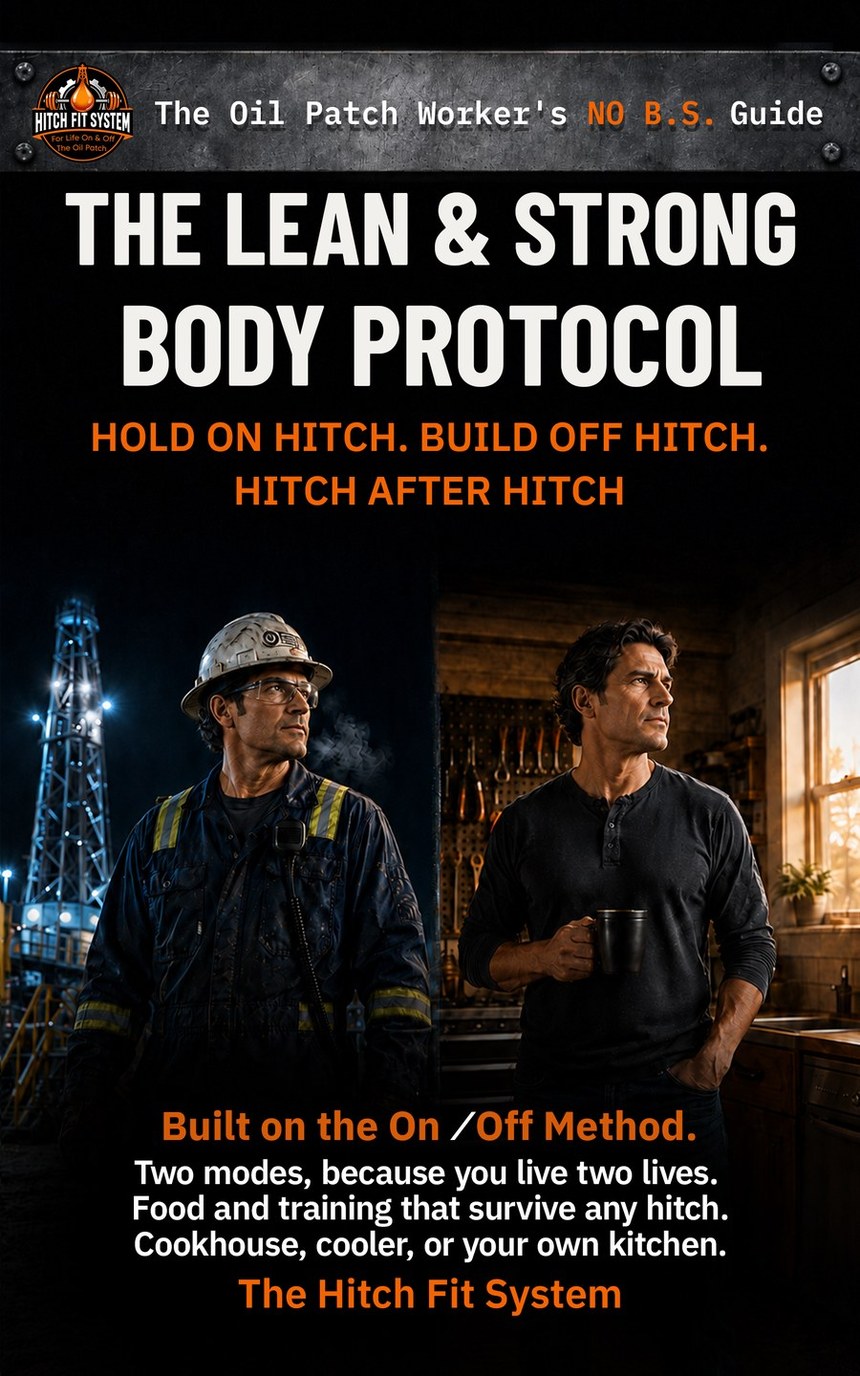
From a dry room in Bitumount
Wood Buffalo, Alberta.
Monday, 5:40 a.m.
Dear oil patch worker,
You come home. You look at yourself. You think, “how did I let this get away from me again?”
And you know you didn't sit on a couch. You worked twelves in minus thirty.
Then this is the best $67 you'll spend this year.
Here's why.
I'm not going to give you my name. It isn't the part that matters.
Here's the part that does. Twelve years of hitches, and counting.
Nexen Long Lake. Albian Sands. Suncor Base Plant at Steepbank.
Nine years at Fort Hills, where I still work today.
I am not a coach. I have never had a client. I have a badge, a locker, and a bus at 5:30 like you do.
And for about six of those twelve years, I got quietly, steadily worse.
Not dramatically. Nobody points at you.
It's a belt notch a year. It's the coveralls that fit fine in 2019 and don't now.
It's taking the stairs slower than the apprentice behind you. And telling yourself it's the boots.
Not one of them failed on day one. That's the part that used to get me. Day one I was great. I was the one with the containers. I was the one at the gym at 5 a.m. before shift.
Then the back half would show up. A flip to nights. A turnaround. Sixteen hours instead of twelve.
Or a camp gym with three treadmills. Two out of order. And somebody in a stringer parked at the only mirror.
By the time I flew home, everything I built the week before was gone.
And I filed it under “I need to want it more.”
That went on for years. Four plans, four funerals, one conclusion: the problem is me.
Then one day off, sitting at my own kitchen table, I actually read one of those plans properly.
And I found the thing that had been beating me the whole time. It was in the first four pages of every single one of them, hiding in plain sight.
Every plan I had ever bought assumed I had four things.
I get none of the four for half the year. And all four for the other half.
That is not one situation. That is two. And they want opposite things from you.
Once I saw it, I couldn't unsee it.
So I stopped trying to be more disciplined. I built two plans instead of one.
One for on hitch. One for days off. And a procedure for the changeover, both directions.
Because the changeover is where the whole thing was actually falling apart.
I ran it on 4/3. On 7/7. On 14/14.
Out of a camp room. Driving in from town. Through flips, turnarounds and call-outs.
One stretch, the gym was a band and a floor that smelled like carpet cleaner.
It held. Hitch after hitch after hitch.
Not fast. I'll say that more than once on this page.
But it held. Nothing else ever had.
People on my crew started asking what I was doing.
I'd explain it in the line, tray in hand. That's a terrible way to teach anybody anything.
So I wrote it down. Twenty chapters. Eight bonus sections. 130 procedures. Every one tagged, so you know whether to run it on hitch, on your days off, or on a travel day.
It's called The Lean & Strong Body Protocol, and it is the first of five.
Run it on your next hitch. Not next January.
Run It On Your Next Hitch — $67Book · audiobook · 2 field cards · App free 120 days, then $27/mo, cancel anytime · Full refund inside three hitches, keep everything
Or take all five — Founding Crew $197 · 100 seats · Closes October 10
Get all five instead — $197 →Get all five — The Complete System $297 →
Who this was built for
Nodded at even one? Keep reading.
The rest of this page is about what's actually beating you. It isn't the food. It isn't your willpower.
First, the door
I'd rather lose the sale than take money from someone this won't fit.
Still here? Good. Let's talk about the part nobody outside the fence sees.
The arithmetic nobody outside the gate does
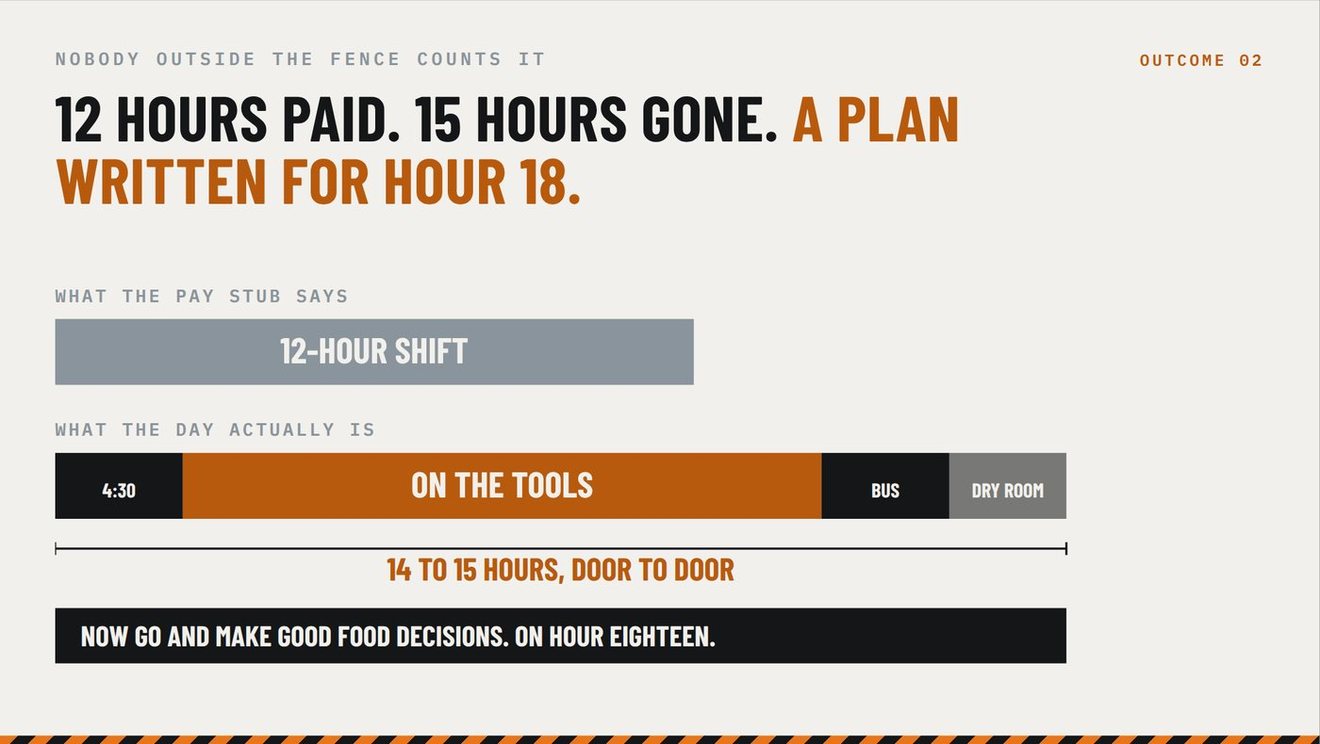
Alarm at 4:30 in a room that smells like carpet cleaner. Three minutes to the bus with the wind straight through your Carhartts. The yellow bus where nobody says a word.
Twelve on the tools. The ride back. The dry room, four hundred pairs of boots, that smell that gets into your hair. The lineup.
Door to door it's fourteen or fifteen hours. A twelve-hour shift, forty-five to sixty minutes each way, plus pre- and post-shift on site. Nobody outside the fence counts it that way.
Ask anyone out there what their shift is and they'll say twelve. Ask what their day is and they'll tell you nineteen, because that's what alarm-to-lights-out feels like.
Now go and train. Now go and make good food decisions. On hour eighteen, with your judgment running on fumes.
You have Day 3 of nights. You have Day 2 home.
Those are the units your life comes in. Not one plan on the market is written in them.
It's all you can eat and it's already paid for. Everybody's going back for seconds and nobody thinks twice about it.
Here's what the diet industry won't say out loud.
It's the one warm, easy, generous thing in a long stretch away from home. You'd have to be strange not to want it.
So the portion gets away from you. Not once — twice a day, every day you're out there.
Two scoops of gravy can beat the meat underneath it. Nobody at the carving station is going to mention that.
Deep into the back half and you can't look at the pasta bar. You'd commit minor crimes for a vegetable that hasn't been boiled into submission.
Researchers at the University of Alberta asked oil sands workers to describe camp life. The word participants used most often was “prison.” (Dorow et al., reported in The Globe and Mail.)
You drive in, so nobody ever assumed you had a problem. You've got your own kitchen. Your own groceries. Every tool.
Alarm at 4:15. Out the door by 4:40. Up the highway in the dark.
Twelve hours. Then the same road home, with oversize loads coming the other way.
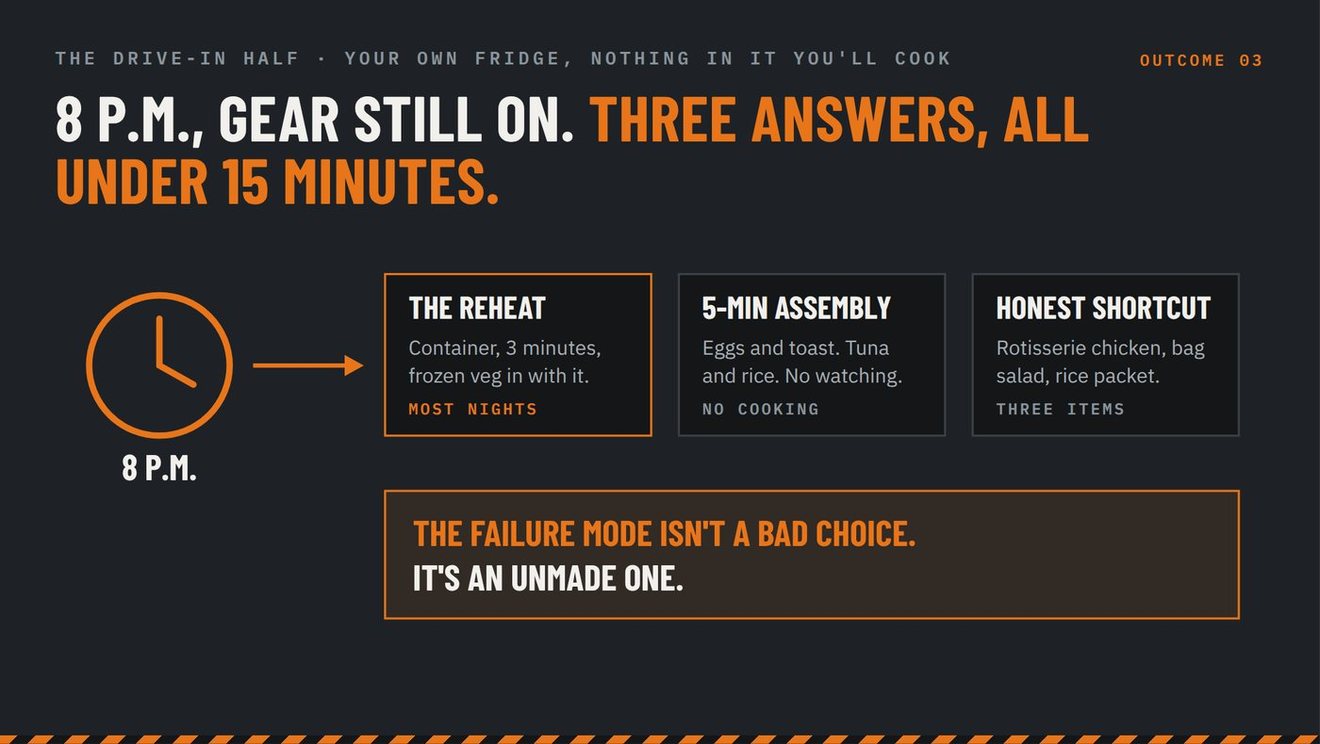
You're through your own door around 8 p.m., gear still on.
You open a fridge you technically control. There's nothing in it you're willing to cook.
You have every tool and none of the resources — because what ran out isn't food. It's hours and it's willpower, and both of those went to the job.
So it's the drive-thru on the way in tomorrow. The one you told yourself you weren't stopping at.
This is the one that actually costs you.
You go home. You sleep. You eat properly. You get three good sessions in.
By Day 4 off you feel like yourself again. You catch yourself in the truck window and think yeah, there I am.
Then you go back. And by the back half it's gone.
Where it lands depends on your schedule. On a 14-and-7 it's Day 8. On a 7-and-7 it's the fifth one back. On a 4-and-3 it's the second.
Same story, different date. The back half takes back what your days off built.
You are running up the same hill, every hitch, all year, and never once getting to the top of it.
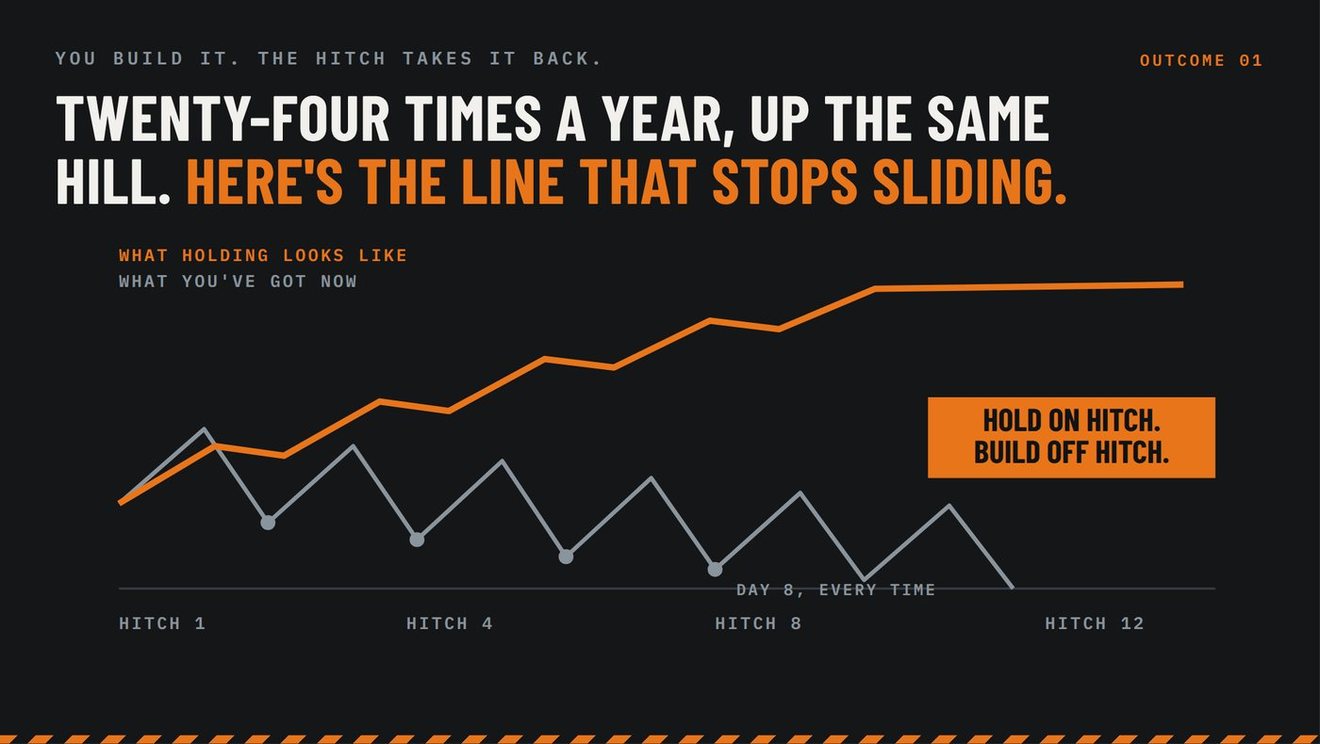
You come home a little heavier each time and you can't work out why. Your back and your knees are already talking, and you're nowhere near done out here.
Do that for however many hitches you’ve got left and the arithmetic finishes the sentence for you.
You already know the one.
Twenty-five years deep. Two marriages gone. Knees done, shoulder done. Truck's paid off because it's a 2011. Something for the back, something for the pressure, something to sleep.
Two million dollars earned over a career. Best-paid work you can get without a degree.
What's left is a truck and a storage unit.
Nobody on that crew is laughing. Half of them are on the same road and they know it.
They didn't get there in one bad decision. It happened one hitch at a time.
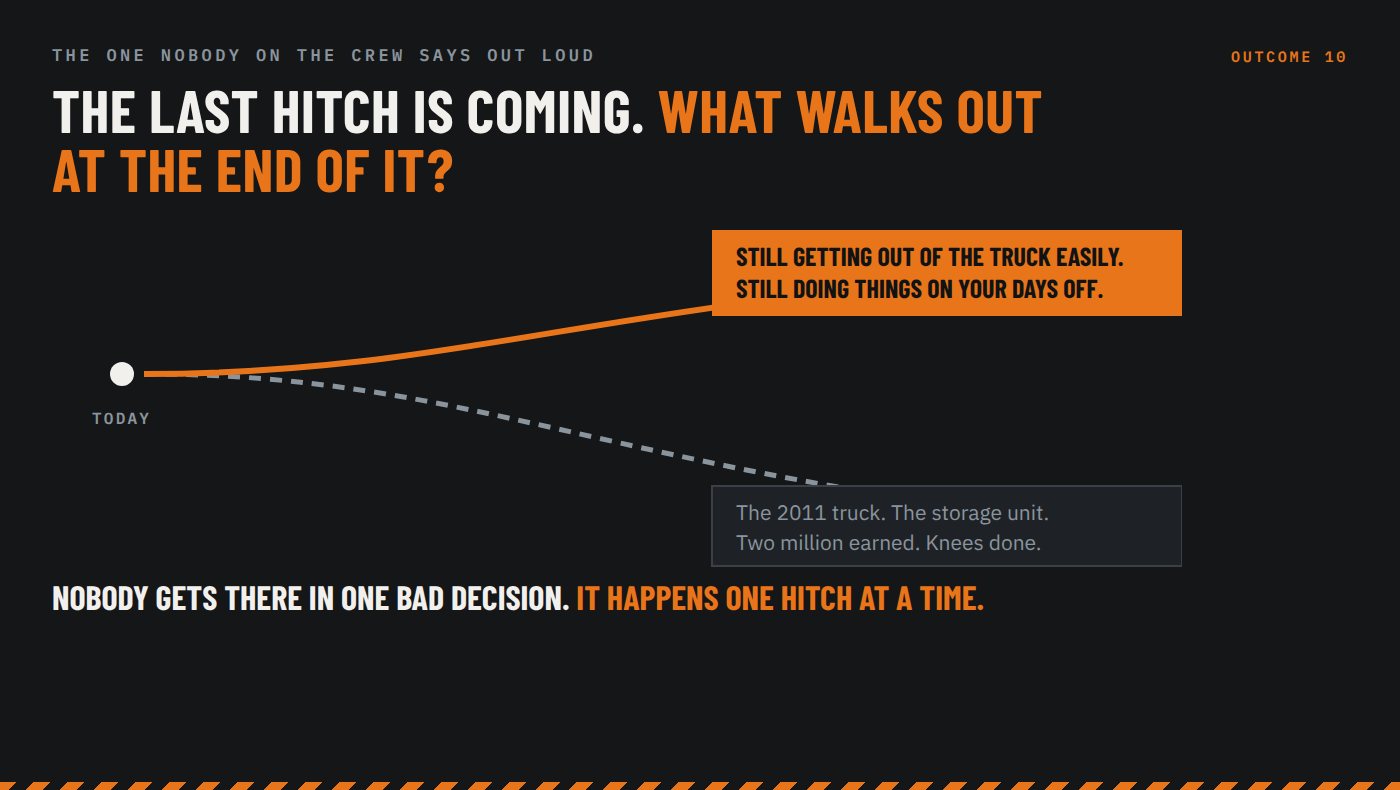
The back half of every hitch is coming either way. Have a plan for it.
Get The Book, The Audiobook And The AppBook · audiobook · 2 field cards · App free 120 days, then $27/mo, cancel anytime · Full refund inside three hitches, keep everything
Or take all five — Founding Crew $197 · 100 seats · Closes October 10
Get all five instead — $197 →Get all five — The Complete System $297 →
Why this one holds when the last four didn't
One set of rules cannot cover both halves of your year. So there are two, and a changeover.
You're on hitch. The job is not to make progress.
The job is to hold what you've got. Arrive at your days off with something left.
Protein first. Portions steady. Two or three short sessions. A hard time cap you set before you walk in.
You're home. Real food. Real loads. Real recovery.
This is the only half where you control every input. So it's the only half where you build.
Everything you eat on hitch got decided here — on a day you had hours and a working brain.
Day 1 off and Day 1 back are each their own job, with their own procedure.
This is where most people quietly fall apart. Both directions. And almost nobody plans for it.
You run on a body clock. It decides when you're hungry, when you're tired, and how you handle food.
Flip through days and nights and that clock never fully sets.
Run short on sleep and your body makes more of the hormone that says eat. And less of the one that says you're full.
That's hour ten and the vending machine. Two hours after a full plate.
That is not a lack of discipline. That's your own hormones lying to you because you haven't had a real night's sleep in three days.
So here's what that means.
In a deficit, wrecked, eating out of a kitchen somebody else runs, your body's honest best is to hold what you have.
Ask it to build there and it won't. Push harder and you'll just arrive home wrecked and quit in week three.
Then you get home. You sleep. You eat properly. You put real weight on the bar. That's when it builds.
Run one plan across both halves and you spend a whole career losing slowly.
Inside the book
20 chapters, 8 bonus sections, 130 procedures. Every one tagged On Mode Off Mode or The Switch so you always know when to run it.
Book · audiobook · 2 field cards · App free 120 days, then $27/mo, cancel anytime · Full refund inside three hitches, keep everything
Or take all five — Founding Crew $197 · 100 seats · Closes October 10
Get all five instead — $197 →Get all five — The Complete System $297 →
The training half
Fuel, supplements and the stuff nobody tells you
Book · audiobook · 2 field cards · App free 120 days, then $27/mo, cancel anytime · Full refund inside three hitches, keep everything
Or take all five — Founding Crew $197 · 100 seats · Closes October 10
Get all five instead — $197 →Get all five — The Complete System $297 →
The part you actually carry
A book is for a day off and a couch. It is no use at all at 4:30 in the morning in the back half of a hitch.
So the two things you’ll run most often came out of this book and onto two single pages. Print them, fold them, put them in the kit bag. They’re in the app too, but paper doesn’t need a signal or a battery.
New, and they don’t exist anywhere else. Both are pulled straight out of chapters you’re already buying.
Card 01 · From Chapters 5–6
How to read the servery before you pick up a tray. Palm, fist, thumb. The ten-second, three-question check that replaces a food scale. No arithmetic, no phone out in front of the crew.
Card 02 · From Chapter 7
For the drive-in half. What actually lives in the cab, the decisions that solve the 8 p.m. problem before you get in it, and the one stop on the way home that decides the whole evening.
Take all five Protocols and you get all five cards.
Before you decide I'm the same as the last four
I'm not going to pretend you've been sitting on your hands. You've spent money on this problem. So have I.
Here's the honest post-mortem on every option in front of you. Including the ones I'd still tell you to use.
So what's actually different about this one?
One thing, and it's the only thing: every option above is one plan. You're not one situation. You're two, and they want opposite things from you.
Run a build plan on hitch and your body will refuse. You're in a deficit, wrecked, in someone else's kitchen.
Run a holding plan on your days off and you'll go nowhere, hitch after hitch. While controlling every input you'll ever control.
That's not a marketing angle.
It's why four plans died on you. And it's why this one is built as two.
You don't have to believe me. You have to run it for three hitches.
If it hasn't earned its place in your kit, you get the money back and keep the books.
Fair enough
Three pages, lifted straight out of it, unedited. Click any page to bring it to the front. If you like how these read, you'll like the other three hundred.
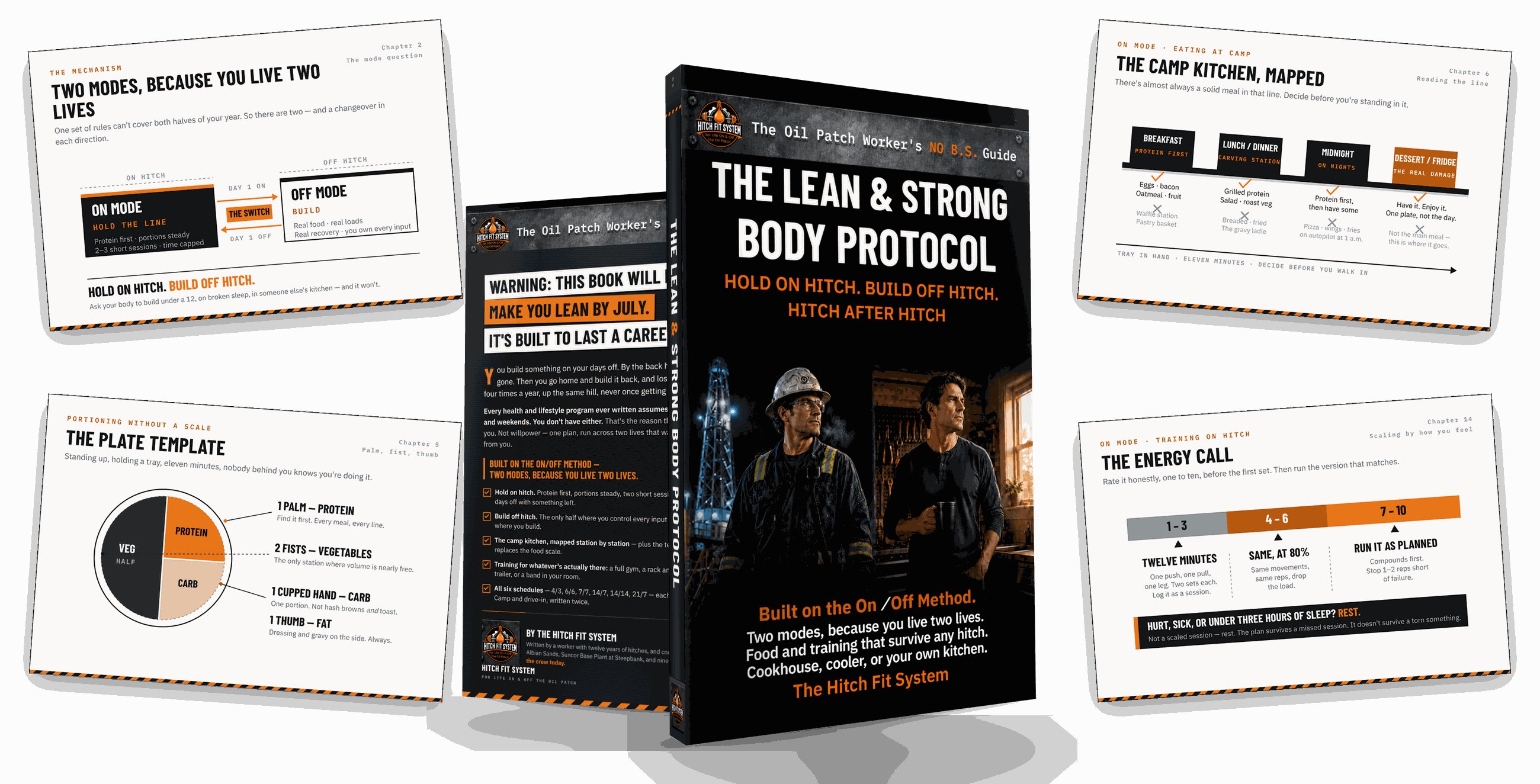
Four of the diagrams inside · The two modes · The plate template · The camp kitchen, mapped · The energy call
On Mode Off Mode Before every meal, ten seconds, in order:
That's it. That replaces the food scale.
Excerpt · The Lean & Strong Body Protocol
On Mode You're home, you're wrecked, and something has to happen in the next fifteen minutes or delivery wins. Run one of these three. Pick your favourite now, before you need it:
What matters is that all three are decided in advance and all three take under fifteen minutes. The failure mode isn't a bad choice. It's an unmade one.
Excerpt · The Lean & Strong Body Protocol
On Mode Rate your energy honestly, one to ten, before the first set. Then:
That last line is not a loophole. Training through an injury or a fever on a hitch schedule doesn't make you tough, it makes you unavailable later. The plan survives a missed session. It doesn't survive a torn something.
Excerpt · The Lean & Strong Body Protocol
That's the voice of the whole book. No hype, no shame, no “crush it.” Just the thing to do, and when to run it.
The part where a page like this usually shows you 6,000 five-star reviews
This book launches on September 10, 2026. Nobody has run it for three hitches yet, because three hitches haven't happened yet.
I could go get some. You know how it works.
A few glowing quotes. Stock photos. Initials and a job title. Half the pages you've bought from did exactly that.
I'm not doing it. Not because I'm a saint. Because you work out there, and people who work out there can smell it.
One fake quote from “D.M., Pipefitter” and you'd close this page. You'd be right to.
So here is every piece of proof I actually have, and nothing else:
When there are real ones, they'll go here, with real names from real crews. Until then, this space stays empty and honest.
What the research actually says
FIFO workers surveyed who were overweight or obese, against the general adult population. Fruit and vegetable intake was low.
Asare and colleagues, International Archives of Occupational and Environmental Health, 2022.
That gap is real. And it's four points. I won't inflate it or round it up.
You've probably seen the “eight in ten oil workers” number. It traces back to 35 men at one site. I won't use it.
Because here's the thing: you already know you're heavier than you were. You don't need a study for that. You need a mirror and a pair of coveralls from 2019.
What you haven't been told is why the line and the twelve beat you specifically — and exactly what to run instead. That's the book.
Built for your schedule. Whatever it is.
Pattern with no name? 8-and-6, turnarounds, call-outs, a board that changes every month? The guide builds you your own split from your ratio of days on to days off.
Some of you eat at a camp kitchen built to feed three thousand people. Plenty of you drive in from town and own every meal you eat — in theory.
Two different problems. Every procedure in this guide is written twice, once for each.
Camp gets its own chapter. So does the commute. Neither is treated as the real version.
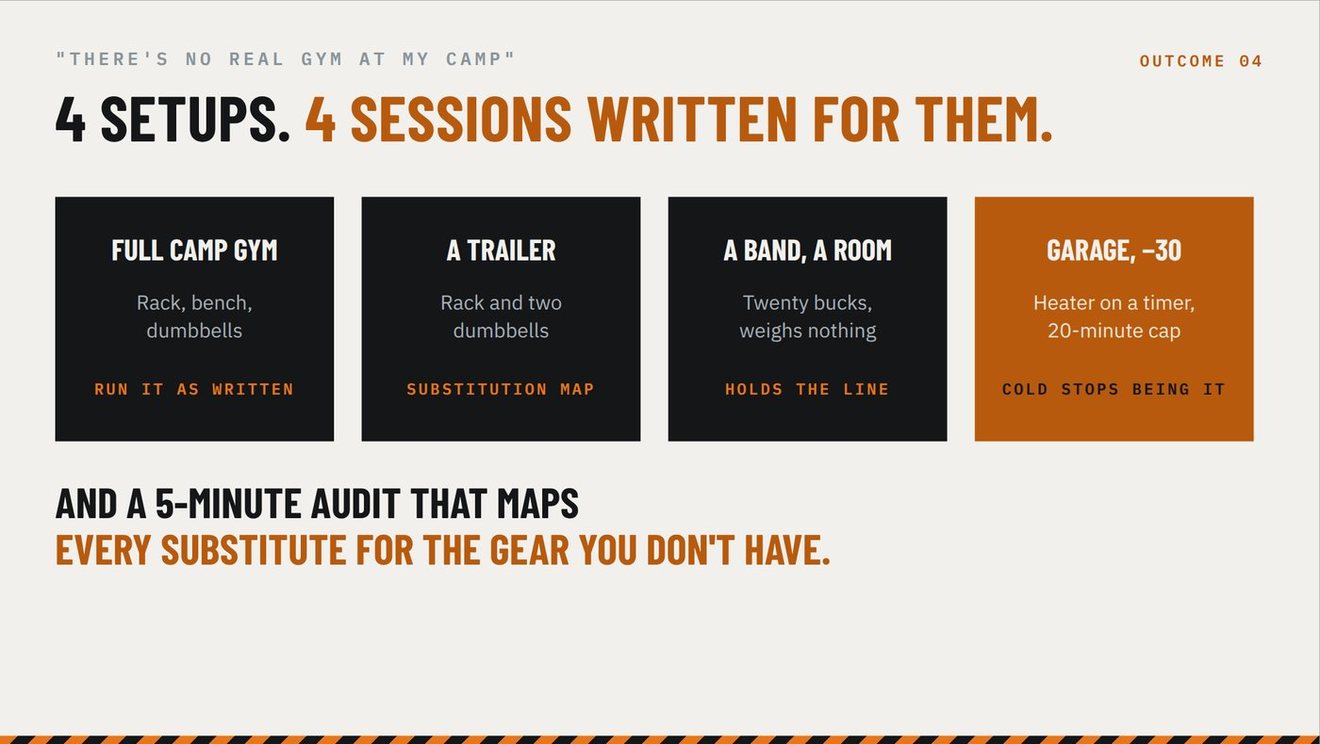
A decent camp gym. A rack and two dumbbells in a trailer. A town gym that shuts at eight. A garage at minus thirty. A band in a room.
All of them get a session written for them.
Scaffolders. Pipefitters. Welders. Millwrights. Electricians. Instrument techs. Insulators. Operators. Labourers. Safety. Camp staff. Turnaround crews. Anybody on the oil patch working twelves on a clock they didn't pick.
Gender-neutral the whole way through. Not as a disclaimer.
The supplement chapter carries a full women's section. The training chapters don't assume the crew is male.
Sleep on these schedules is documented as markedly worse for women. Almost nobody in this category writes to that at all.
What running it actually does
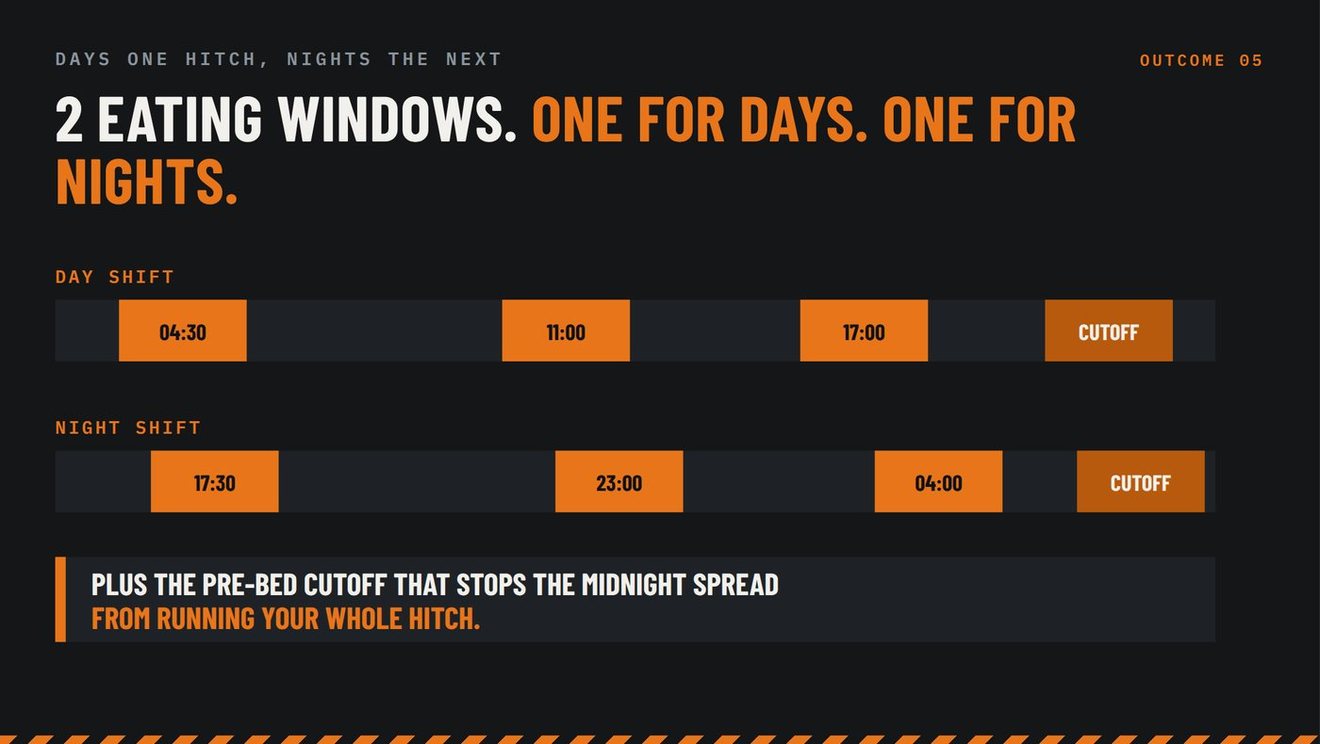
And a rate of loss with a floor under it. Plus a plain warning about when to stop cutting and go see a doctor instead.
What you won't get is a promise about your weight or your body fat. Nobody honest can make one, and I'm not going to start on the page where I'm asking you for money.
What lands in your inbox, in about a minute
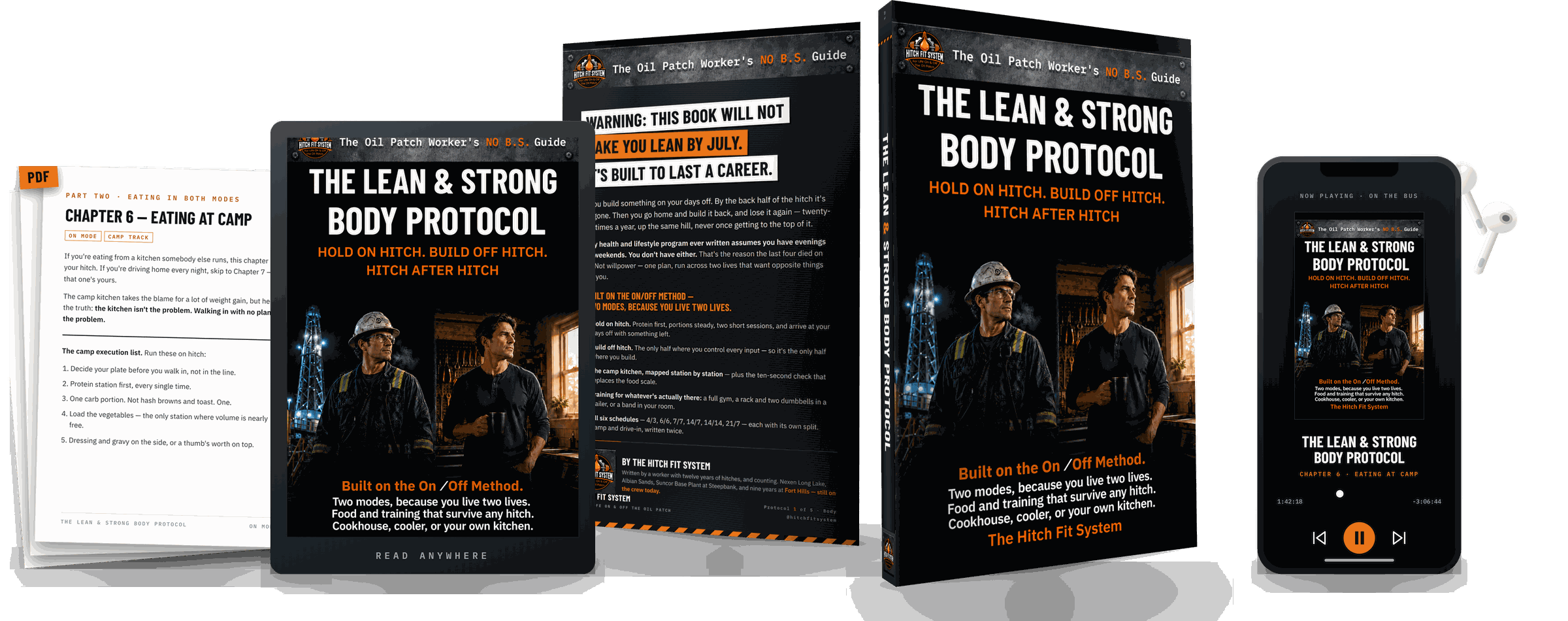
Read it · Print it · Or listen to the whole thing on the bus · All included at $67
20 chapters · 8 bonus sections · 130 procedures
Every procedure tagged On Mode, Off Mode or The Switch. So you always know when to run it.
All six schedules get their own split. Camp, commuter, home and road tracks all the way through.
One hitch where you hold instead of slide is a hitch you don't have to buy back.
Included. Not an upsell. Not a separate price.
The whole guide, read start to finish. Not a summary.
Half this crew will never open a PDF. They will absolutely listen on the bus, in the truck cab, or in the dry room waiting on a ride.
Download it before you fly out. It works with no signal at all.
Free for 120 days — the whole guarantee window. Then $27 a month, cancel any time.
It knows which mode you're in before you open it. It logs a shift in about sixty seconds.
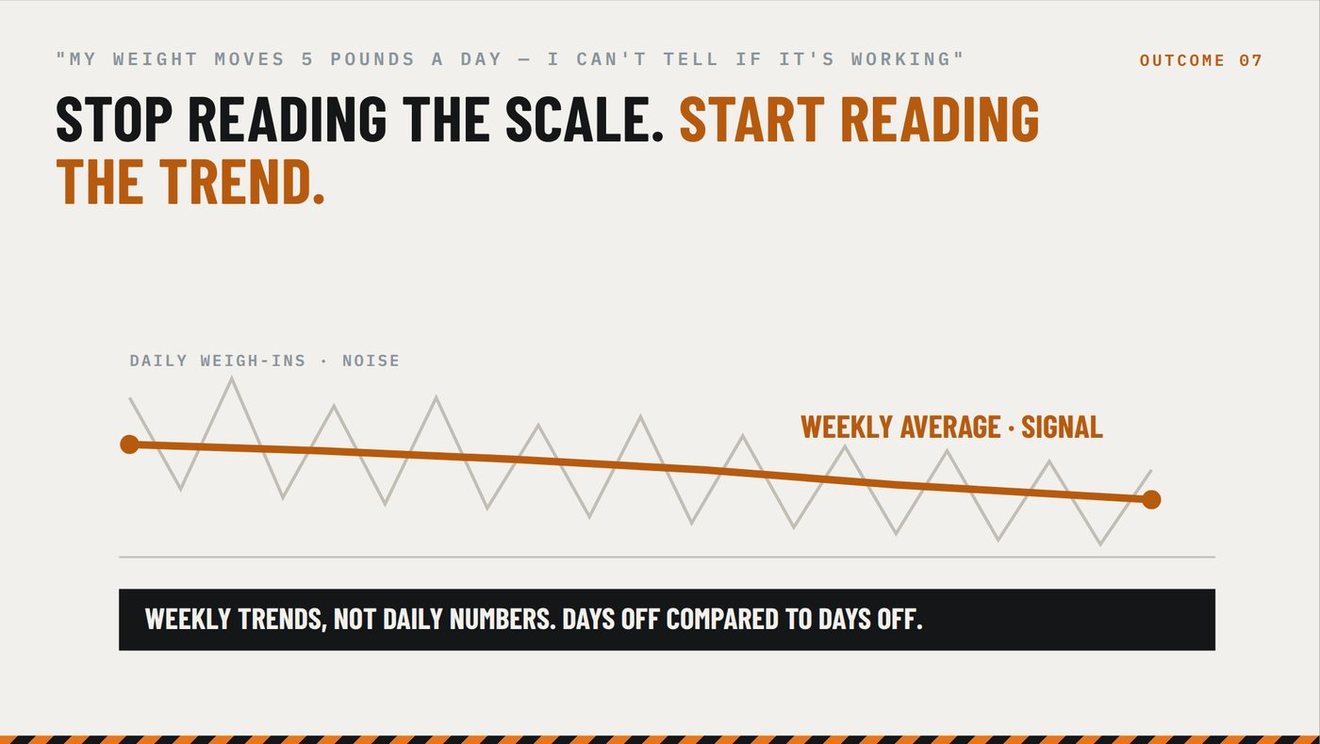
It filters your training by the gear in front of you. And it shows the weekly trend, not the daily noise.
A fitness app runs $80 a year at the honest low end, $240 if you pay monthly — and every one of them assumes you have a Tuesday.
Plus four cheat sheets in the appendix — camp, commuter, home and road — and a plain-language FAQ.
Book, audiobook and the Hitch Fit App. One price.
Try It For Three Hitches — $67Book · audiobook · 2 field cards · App free 120 days, then $27/mo, cancel anytime · Full refund inside three hitches, keep everything
Or take all five — Founding Crew $197 · 100 seats · Closes October 10
Get all five instead — $197 →Get all five — The Complete System $297 →
Before you buy, the honest part
What I can hand you is the method. You run it.
Included · Every copy, every tier
Here's the problem nobody warns you about when they hand you a book.
It's brilliant on your days off. Couch, coffee, nodding along. This is finally the one that sticks.
Then you're back on site at 4 a.m. Boots half-laced. Eleven minutes to eat.
And the book is three hundred kilometres away, in a drawer.
Knowledge you can't reach in the moment isn't a method. It's a good intention.
That's the gap the app closes. The book teaches the method once. The app runs it with you, every shift.
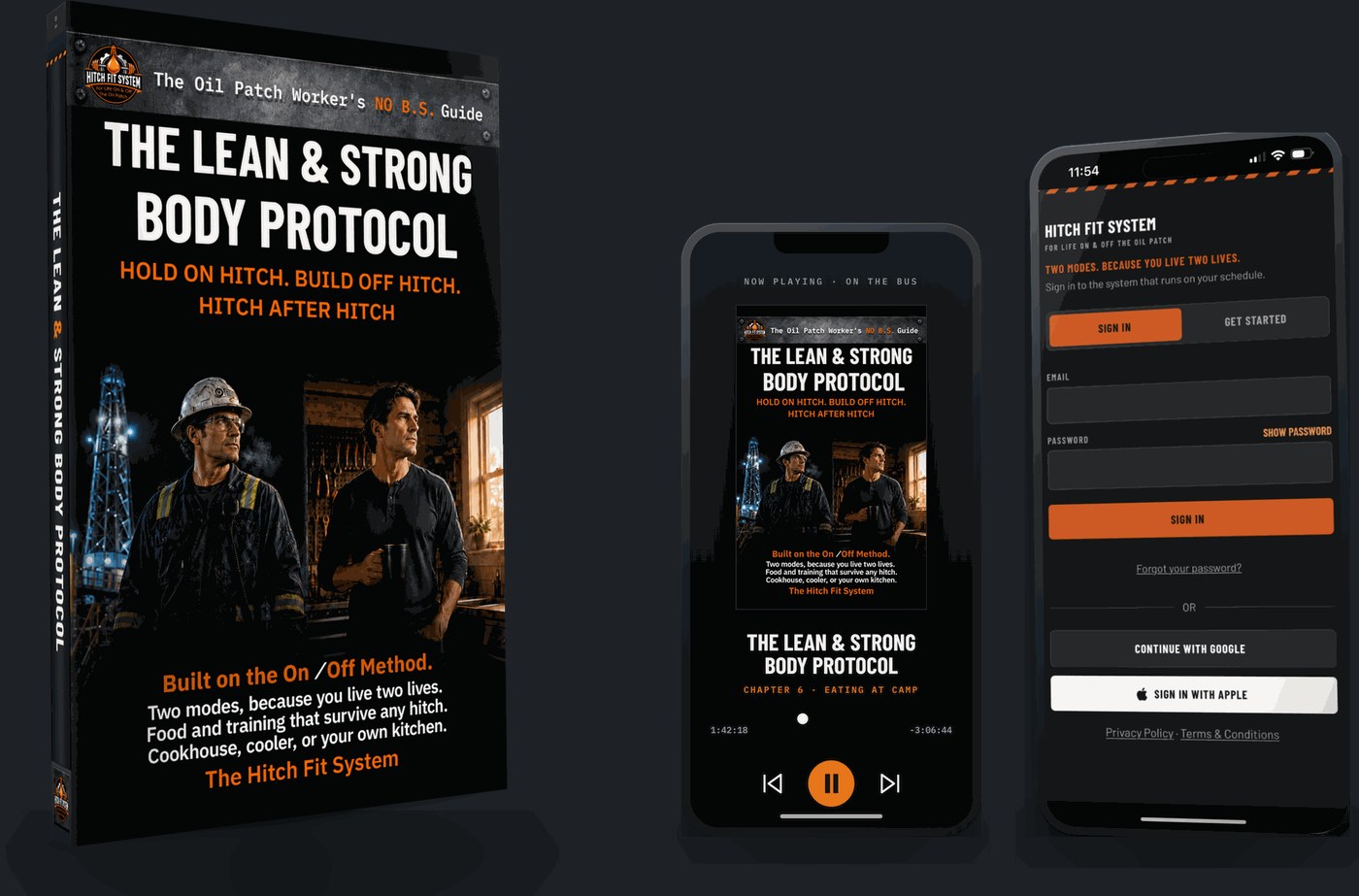
Book · Audiobook · 2 field cards · App free 120 days — $67, no upsell on the way in
The Hitch Fit App isn't a general fitness app with an oil patch skin painted on. It's built around the two modes.
Tap any one of them.
Set your hitch once at onboarding. 4/3, 6/6, 7/7, 14/7, 14/14, 21/7, or your own pattern.
The app builds a calendar. It knows if today is On Mode, Off Mode or a switch day — before you've opened it.
Your whole plan switches with it. Travel day landed somewhere odd? One tap overrides it.
On Mode logging drops calorie counting. Tap what you took, note the portion, done in ten seconds.
A quick-lookup card gives ballpark ranges for real food. Steak, prime rib, chicken breast, eggs, fries.
Then one daily yes or no. Did you hit your protein today? On hitch, that's the only question that matters.
Off Mode switches you to fuller tracking the moment your calendar says you're off. Same login, zero setup.
A grocery list builder and a batch-cooking planner come with it. The app builds the Off Mode chapters with you, so you don't have to remember them.
The app filters your workout view by what's actually there. A room with a band. A half-equipped trailer. A home garage. A full gym.
You only ever see what you can run.
The programming also adjusts to your job. Heavy manual work gets joints first, with volume scaled down on your hardest days.
Mostly sitting? Conditioning and posture. Mostly standing? Lower back and feet.
The 60-second daily log is built to actually get used. One screen.
Shift type, weight, waist, sleep, an energy slider, two toggles, steps, notes.
The calendar shows your whole hitch at a glance. One tap to bulk-edit.
Streaks, a hitches-completed count and milestone markers give you something to watch build.
The weekly trend view plots week-over-week averages for weight, waist, sleep and energy — not daily noise. It's the tracking rule from Part Five, built into the software instead of left for you to work out by hand.
Onboarding takes a few minutes and hands you something most plans never do: an honest number, with a floor attached to it.
Enter your starting weight and waist. Set your target rate between 0.5% and 1% of bodyweight a week.
The app tells you what that means in weeks.
And it will flag you if that rate is too aggressive for twelve-hour physical shifts.
Not many things you buy argue with you in your own interest on the first screen.
Then: one 60-second log a shift, ideally before bed. Let the calendar run the changeovers — it already knows. Once a week, open the trend view instead of the scale.
Book · audiobook · 2 field cards · App free 120 days, then $27/mo, cancel anytime · Full refund inside three hitches, keep everything
Or take all five — Founding Crew $197 · 100 seats · Closes October 10
Get all five instead — $197 →Get all five — The Complete System $297 →
The price
Once. Book, audiobook and two field cards — yours to keep. The Hitch Fit App free for 120 days, then $27 a month.
I'm not going to compare that to another book. Here's what I'll compare it to.
| What it costs | What it can't do |
|---|---|
| $1,800 a year | A full supplement stack at $120–150 a month. Never once stood in a servery line for you. |
| $90 an hour | A personal trainer. You can afford one. They still can't meet you on site at 5 a.m. on the back half of a hitch. |
| $150 a scan | A DEXA scan. Tells you exactly where you are and absolutely nothing about what to do at the line tomorrow. |
| $80 a year, min. | A fitness or nutrition app subscription — billed forever, and it assumes you have a Tuesday. Yours is in the $67, once. |
| Years of back halves stacking up | Adding up quietly. And the version of you who walks out of here to collect it. |
$67 is a round of drinks on your first night home. Or half a tank in the truck.
You've spent more than that on a plan that died on you. Probably four times.
My “measured in hitches, not days” guarantee
Run it for three full hitches. Not read it — run it. If it hasn't earned its place in your kit by the end of hitch three, email us and we'll refund you in full. You keep the books.
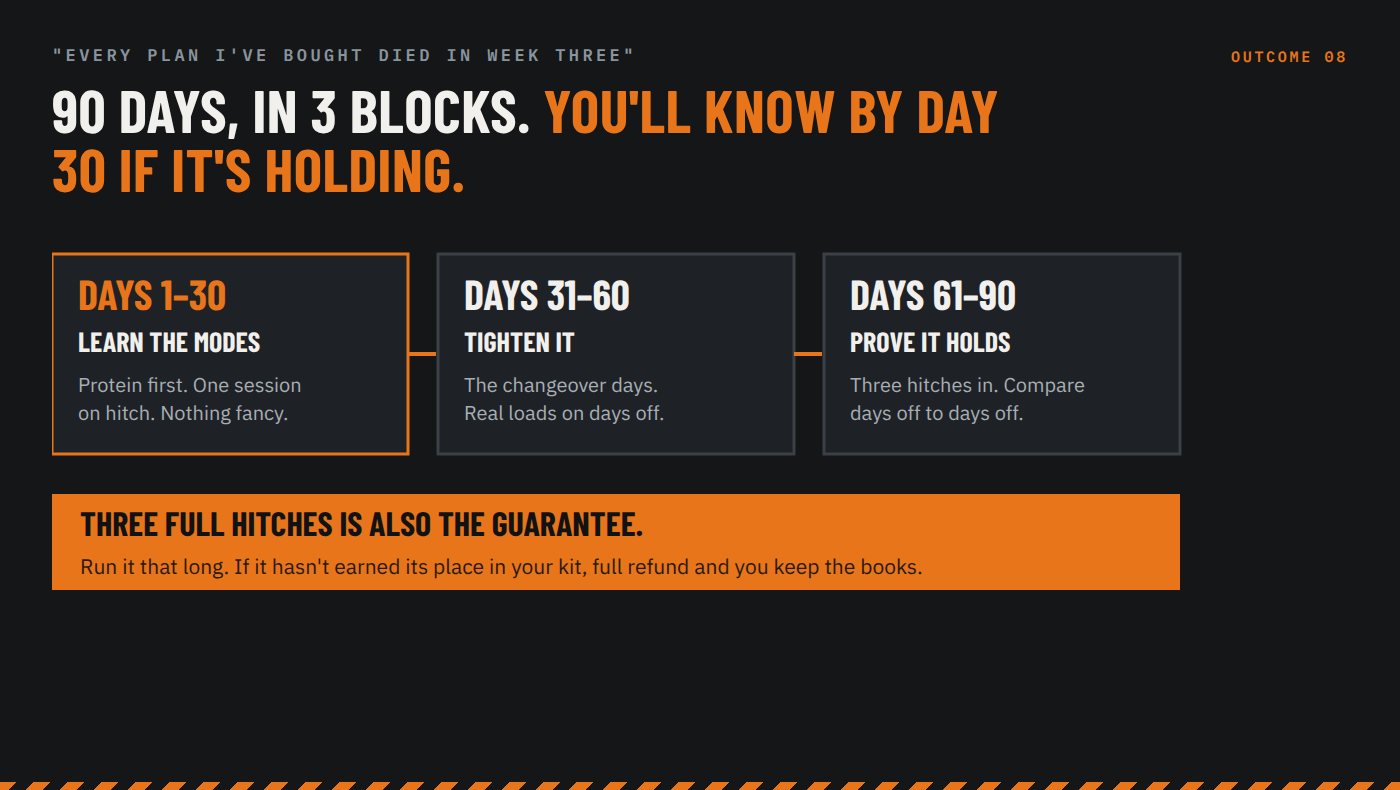
Three hitches, because thirty days means nothing on a 21/7. Thirty days is a hitch and a bit.
It doesn't even show you both modes. Let alone a changeover in each direction.
Your unit is a hitch. So the guarantee is in hitches. There's a 120-day outer window either way.
To be plain: it's a refund guarantee on the method.
It is not a promise about your weight or your body fat. Nobody honest can promise you those.
So run this one for three hitches and find out. That's the whole offer.
If it doesn't hold, I'd rather have your feedback than your $67.
And you keep the books either way. Chasing someone for a refunded file is not a business I want to be in.
Book · audiobook · 2 field cards · App free 120 days, then $27/mo, cancel anytime · Full refund inside three hitches, keep everything
Or take all five — Founding Crew $197 · 100 seats · Closes October 10
Get all five instead — $197 →Get all five — The Complete System $297 →
One thing that does run out
There's no cap on this book. No countdown clock. No “only 3 left.” No stock counter ticking while you read.
Buy it whenever you want. If you're reading this in March, it's still $67.
The one thing with a limit is the Founding Crew. That's The Complete System at $197. All five books, all five audiobooks, the app. Plus lifetime updates and direct input on what gets built next.
The cap is 100 and it closes October 10. After that the Complete System is $297 and the Founding Crew doesn't reopen.
That's not a countdown gimmick. It's the number of people one person on a hitch schedule can actually talk to.
Here's what to do next
Hit the button. Put in your email. The book and the audiobook land in your inbox in about a minute, from BookFunnel.
Download them on decent wifi before you fly out. Then they're yours offline.
Phone, tablet, laptop, or print it for your kit bag.
Camp wifi that dies every time somebody streams a game is not your problem here.
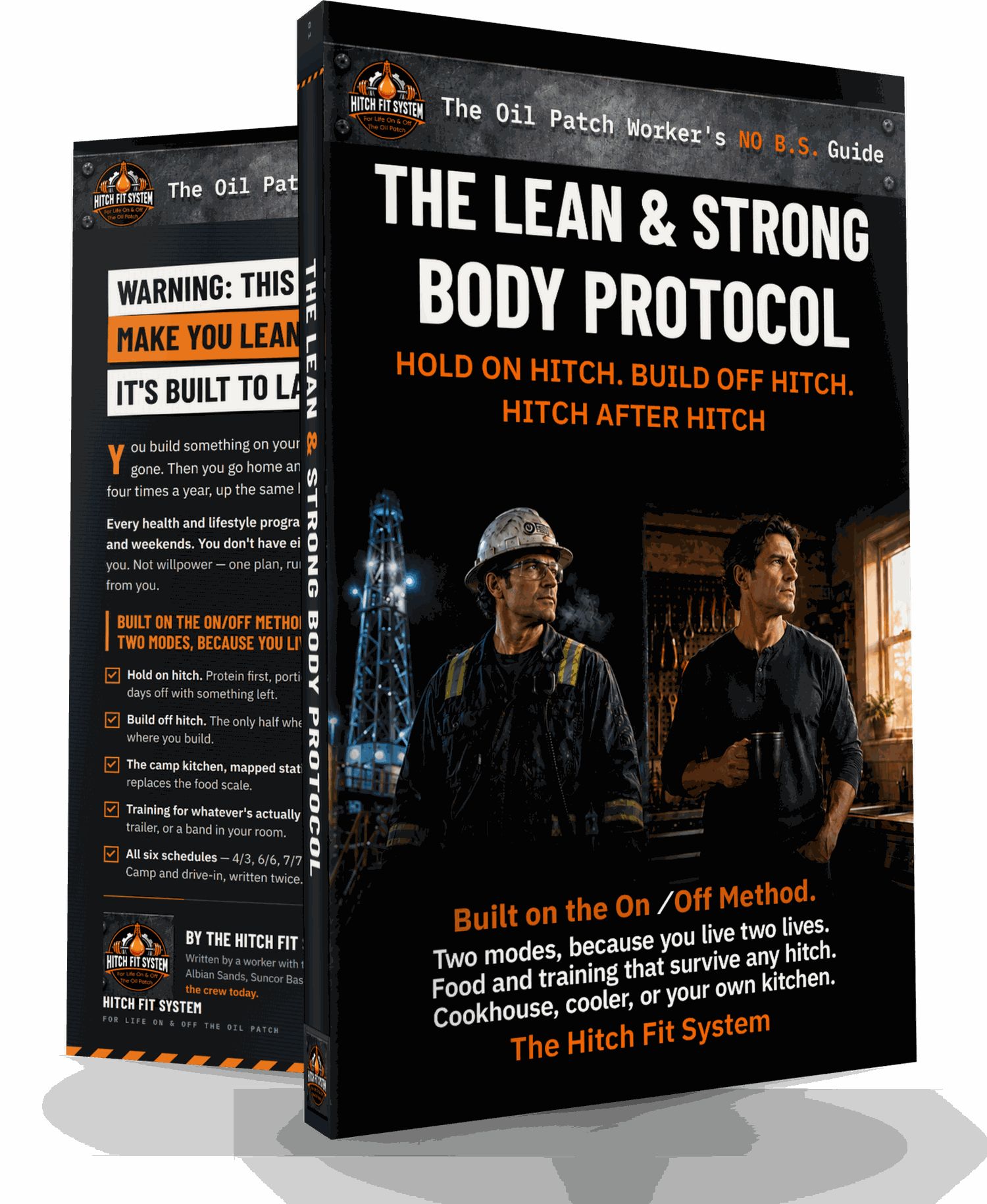
The Lean & Strong Body Protocol · Book + Audiobook + App
One payment for the book, audiobook and cards · App free 120 days, then $27/mo
Book · audiobook · 2 field cards · App free 120 days, then $27/mo, cancel anytime · Full refund inside three hitches, keep everything
Or take all five — Founding Crew $197 · 100 seats · Closes October 10
Get all five instead — $197 →Get all five — The Complete System $297 →
Hold On Hitch. Build Off Hitch.
The next hitch is coming either way. The line will be there. The twelve will be there. The back half of the hitch will be there.
The only question is which plan you walk into it with. One built for a hitch. Or one built for somebody with a Tuesday.
The job is supposed to pay for the life. Too many people out here let it eat the life instead.
The Hitch Fit System Team
Twelve years of hitches, and counting · Still on the crew
You made it to the bottom of a long page. That's more patience than the tool crib line on a turnaround, so here's the short version for the skimmers.
You're not undisciplined. You're running one plan across two lives.
This book gives you two. One for on hitch. One for your days off. And a procedure for the changeover.
$67 gets you the book, the audiobook and the app. Three full hitches to try it. Full refund, keep the books.
Still reading? Alright. Here's the thing I'd tell you standing in the line with a tray in my hand.
Nothing on this page happens fast.
If you want to get shredded before the long weekend, this isn't it. I've said so four times now.
From a sales page, that should tell you something.
What it does is stop the bleeding. You stop handing back on hitch everything you built on your days off. And when that stops, ten years from now looks like a completely different photograph.
Okay, what do you need — a signed affidavit? A ride to the bus?
Look. Worst case: you spend $67 and run it for three hitches.
It doesn't earn its spot. You email us. We refund you. And you keep the books.
You're out precisely nothing, and you got a free audiobook for the drive in.
Best case: you're twenty-five years deep and still getting out of the truck easily, and some apprentice is asking you what you're doing.
Hit the button. Then go pack your bag.
Get The Lean & Strong Body Protocol Now!Book · audiobook · 2 field cards · App free 120 days, then $27/mo, cancel anytime · Full refund inside three hitches, keep everything
Or take all five — Founding Crew $197 · 100 seats · Closes October 10
Get all five instead — $197 →Get all five — The Complete System $297 →
Straight answers
Then you're the reader the training chapters were written for.
There's a session for a full camp gym. One for a rack and two dumbbells in a trailer. One for a band in your room.
Plus a worksheet that audits what you've got and maps substitutes for what you don't.
A set of bands weighs nothing and costs about twenty bucks. It'll hold your muscle for the length of a hitch.
It won't build you like a full gym. It's more than enough to hold the line until you're back at one.
The guide doesn't tell you the camp kitchen is the enemy. It isn't. It's the terrain.
There's almost always a solid meal in that line. You need to know where to look.
And you need to have decided before you're standing there with a tray and eleven minutes.
You get the servery mapped station by station. A plate template you can run without a food scale. And a three-question check that takes ten seconds in the line.
Correct, most days, and the book agrees with you. On Mode training is two or three short sessions across a hitch, not five.
There's a checklist that makes the honest call. Training day, lighter day, or a day you skip on purpose.
Skipping on purpose is part of the method. Not a failure of it.
Hurt, sick, or under three hours of sleep? Rest. That's printed in the book, not buried in a footnote.
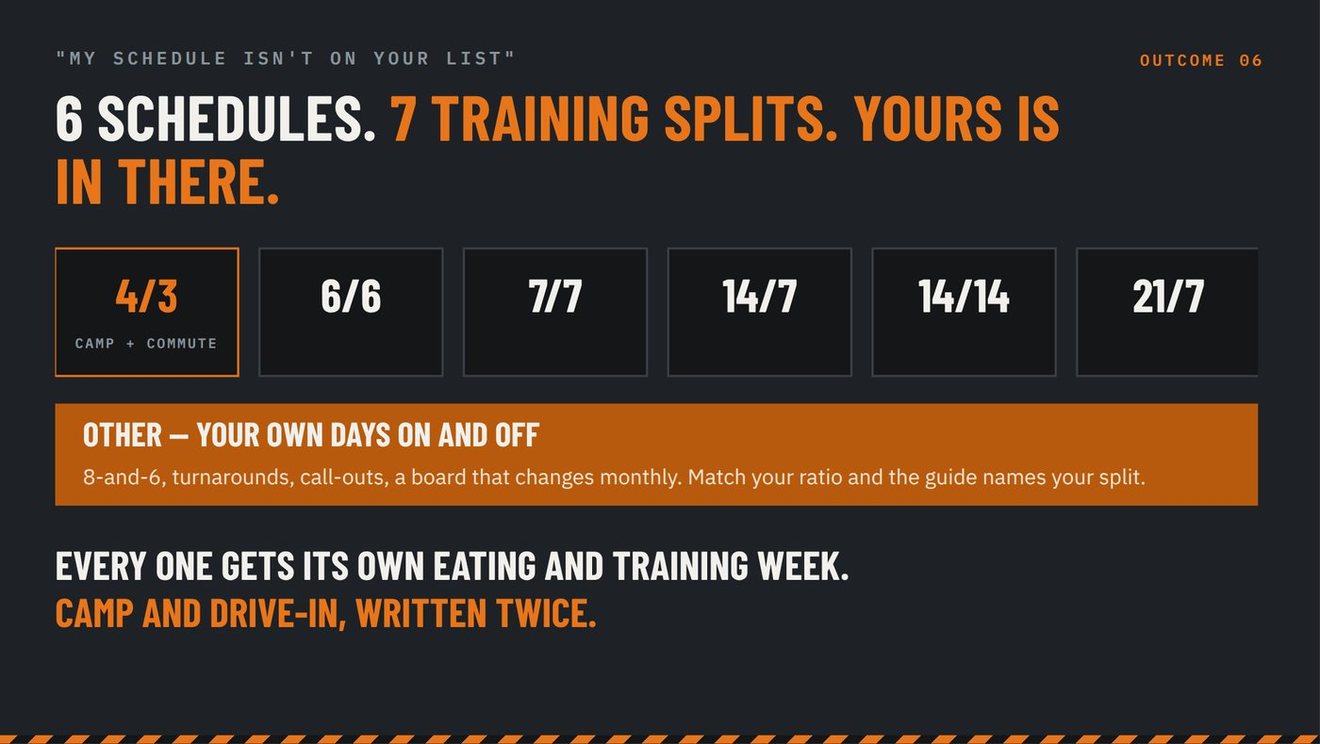
4-and-3, 6-and-6, 7-and-7, 14-and-7, 14-and-14 and 21-and-7 each get their own split.
And 4-and-3 splits again into camp-based and commuting. Those are not the same week.
Anything else? 8-and-6, turnarounds, call-outs, a board that changes monthly.
Match your ratio of days on to days off. The guide tells you which pattern to run it like.
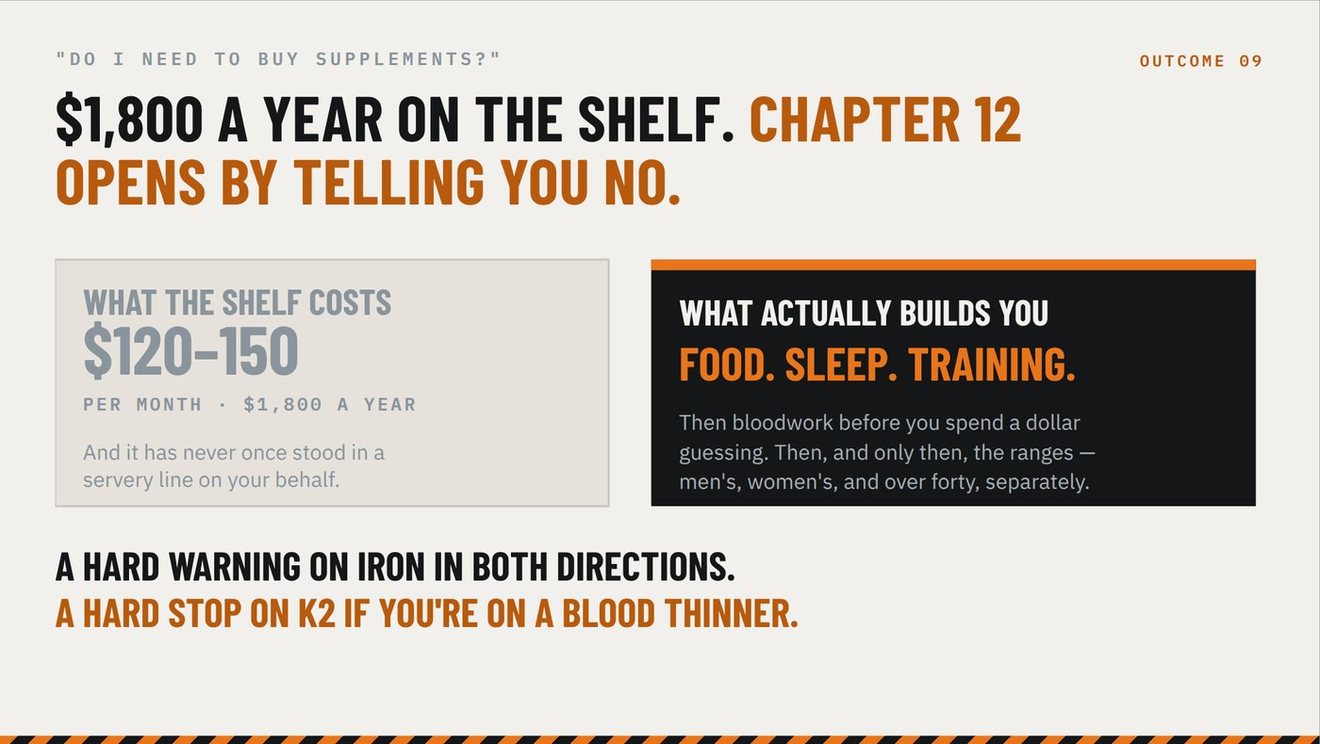
No. Chapter 12 opens by saying supplements don't build your body. Food, sleep and training do. Then it tells you to get bloodwork before you spend money guessing.
There's a hard warning on iron, both directions. And a hard stop on K2 if you're on a blood thinner.
The doses are common ranges, stated plainly. They route you to a pharmacist or your doctor. Not to a shelf.
Then this is the wrong tool, and the book says so in plain language, early, in its own section.
It lists the quiet signs. Then it points you at your family doctor and your operator's employee assistance program. Not at a harder plan.
There is no version of this where asking is the weak move.
Yes, and it's written that way throughout — not with a disclaimer at the front.
The supplement chapter has a full women's section. Iron, bone density, and how a flipping schedule interacts with your cycle.
It routes you to a doctor, not a shelf. And the training and eating chapters don't assume the crew is male.
Phone, tablet, laptop, or print it. Download it once on decent wifi and it's yours offline after that.
The audiobook downloads the same way. Grab it before you fly out and it works with no signal at all.
That's the whole reason it's included at this price instead of sold to you separately.
A quarter section near Sundre, a heated shop and a two-post lift.
…Alright, no. You're getting The Lean & Strong Body Protocol. 20 chapters, 8 bonus sections, 130 procedures, all six schedules.
As a book, the full audiobook, and the Hitch Fit App. Delivered in about a minute, for $67, once.
The app ships with every copy. There is no audio tier, no app tier, and no upsell on the way in.
Every one of those was written for a person with evenings and weekends.
It assumed you eat on a normal clock. That you choose what's in front of you. That you can get to a gym at a set hour. And that next week looks like this week.
You get none of the four for half the year, and all four for the other half. That's not one situation — it's two, and they want opposite things from you.
This book gives you two plans and a changeover, instead of one plan and a guilt problem.
Run it for three full hitches. Not read it — run it. If it hasn't earned its place in your kit by the end of hitch three, email us and we'll refund you in full, and you keep the books. There's a 120-day outer window on it either way.
It's a refund guarantee on the method. Not a promise about your weight or your body fat.
Be suspicious of anyone who gives you one of those in writing.
Sleep, Drive, Days Off, and Hitch to Home.
All five run on the same two modes. That's why Body is the entry point. Learn the mechanism here and the other four make sense from page one.
All five together are The Complete System at $297. Five books, five audiobooks, the app.
Or $197 for the Founding Crew. That adds lifetime updates and direct input on what gets built next.
Capped at 100. Closes October 10.
However many hitches you've got left. Come home with your body intact.
Stop Handing It Back Every Hitch — $67Book · audiobook · 2 field cards · App free 120 days, then $27/mo, cancel anytime · Full refund inside three hitches, keep everything
Or take all five — Founding Crew $197 · 100 seats · Closes October 10
Get all five instead — $197 →Get all five — The Complete System $297 →